
Encyclopedia Americana: Christmas…was not observed in the first centuries of the Christian church, since the Christian usage in general was to celebrate the death of remarkable persons rather than their birth…a feast was established in memory of this event [Christ’s birth] in the 4th century. In the 5th century the Western church ordered the feast to be celebrated on the day of the Mithraic rites of the birth of the sun and at the close of the Saturnalia, as no certain knowledge of the day of Christ’s birth existed.
Encyclopedia Americana: The holly, the mistletoe, the Yule log…are relics of pre-Christian times…. The European mistletoe is thought to have had special ritual significance in Druidical ceremonies and lives in folklore today, its special status as the Christmas mistletoe having come from Anglo-Saxon times. (“Santalales”)
Worldbook Encyclopedia: The exact date of Christ’s birth is not known. The early Christians did not celebrate His birth, because they considered the celebration of anyone’s birth to be a pagan custom…. December 25 was first mentioned in 336… they gradually adopted more and more customs unrelated to the church. Most of the customs originated in cultures that existed before Christianity….In 1643, the Puritans, who regarded such celebrations as pagan, outlawed the observance of Christmas in England. (article “Christmas”).
Encyclopaedia Britannica: “Christianity…by a complex and gradual process…became the official religion of the [Roman] empire. For a time, coins and other monuments continued to link Christian doctrines with worship of the sun, to which Constantine had been addicted previously. But even when this phase came to an end, Roman paganism continued to exert other, permanent influences, great and small…The ecclesiastical calendar retains numerous remnants of pre-Christian festivals, notably Christmas, which blends elements including both the feast of the Saturnalia and the birthday of Mithra (15th edition, volume 10, pages 1062-3)
Encyclopaedia Britannica: Christmas was not among the earliest festivals of the church…Certain Latins, as early as 354, may have transferred the birthday from January 6th to December 25, which was then a Mithraic feast…or birthday of the unconquered SUN. (1946 edition)
Catholic Encyclopedia: Christmas was not among the earliest festivals of the Church…The first evidence of the feast is from Egypt…Pagan customs centering round the January calends gravitated to Christmas.
History of Rome, Michael Grant: Yet there was also another pagan belief during this same epoch, that much more nearly competed with Christ for the control of the Western world. This was the cult of the Sun, which was revered by millions of the inhabitants of the Roman Empire, and its religion for a time even became the state worship…. In Rome, the divinity of the Sun came very early on; and then, centuries afterwards, in the superb dome of Hadrian’s Pantheon, the central opening, surrounded by star-like rosettes, represented the solar orb….Before long, the emperor Aurelian established a massive temple of the Unconquerable Sun as the central and focal point of the entire religious system of the state (274). The birthday of the god was to be on December 25, and this, transformed into Christmas Day, was one of the heritages that Christianity owed to this cult (p. 391- 392).
The Story of the Christian Church, Hurlbut: Everybody sought membership in the church, and nearly everybody was received. Both good and bad, sincere seekers after God and hypocritical seekers after gain, rushed into the communion. Ambitious, worldly, unscrupulous men sought office in the church for social and political influence…. The services of worship increased in splendor, but were less spiritual and hearty than those of former times. The forms and ceremonies of paganism gradually crept into the worship. Some of the old heathen feasts became church festivals with change of name and of worship (p. 79).
The Story of Civilization, Will Durant …Christ was assimilated to the religious and philosophical traditions of the Hellenistic mind. Now the pagan world — even the anti-Semitic world — could accept him as its own. Christianity did not destroy paganism; it adopted it. The Greek mind, dying, came to a transmigrated life in the theology and liturgy of the Church…the Greek mysteries passed down into the impressive mystery of the Mass. Other pagan cultures contributed to the syncrestic result. …From Egypt the adoration of the Mother and Child…From Phrygia came the worship of the Great Mother…. (p. 595).
Origen: …In the Scriptures, no one is recorded to have kept a feast or held a great banquet on his birthday. It is only sinners (like Pharaoh and Herod) who make great rejoicings over the day on which they were born into this world.
Dictionary of Greek and Roman Antiquities, William Smith: …all ranks devoted themselves to feasting and mirth, presents were exchanged among friends, and crowds thronged the streets, shouting ‘Lo Saturnalia.’ An offering was made beneath a decorated evergreen tree, according to the pagan poet, Virgil. Figurines and masks—called ‘oscilla’—were hung on the tree, as are Christmas decorations today. History admits…there can be no doubt that we have in these ‘oscilla’ a relic of human sacrifice… (“Oscilla” 3rd edition, volume II)
Encyclopaedia Britannica: In the Roman world the Saturnalia (December 17) was a time of merrymaking and exchanging of gifts. December 25 was also regarded as the birth date of the Iranian mystery god Mithra, the Sun of Righteousness. On the Roman New Year (January 1), houses were decorated with greenery and lights, and gifts were given to children and the poor. To these observances were added the German and Celtic Yule rites when the Teutonic tribes penetrated into Gaul, Britain, and central Europe. Food and good fellowship, the Yule log and Yule cakes, greenery and fir trees, gifts and greetings all commemorated different aspects of this festive season. Fires and lights, symbols of warmth and lasting life, have always been associated with the winter festival, both pagan and Christian. (15th Edit. Vol. II, p. 903).
Encyclopaedia Britannica: European pagans brought holly sprays into their homes, offering them to the fairy people of the forests as refuges from the harsh winter weather. During the Saturnalia, the Roman winter festival, branches of holly were exchanged as tokens of friendship. The earliest Roman Christians apparently used holly as a decoration at the Christmas season. (“Celastrales”)
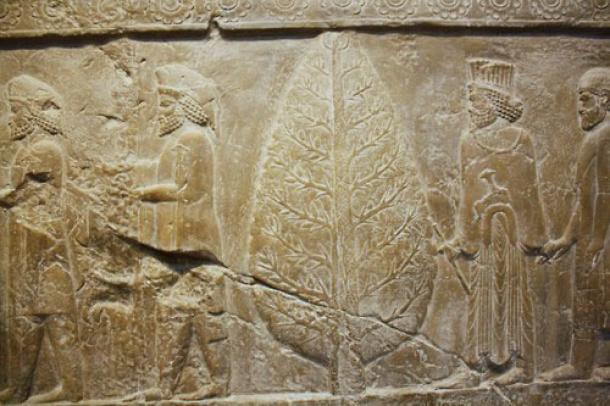
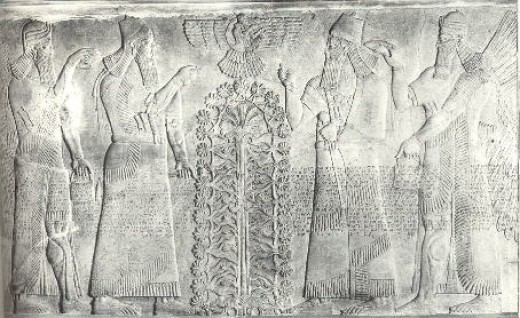
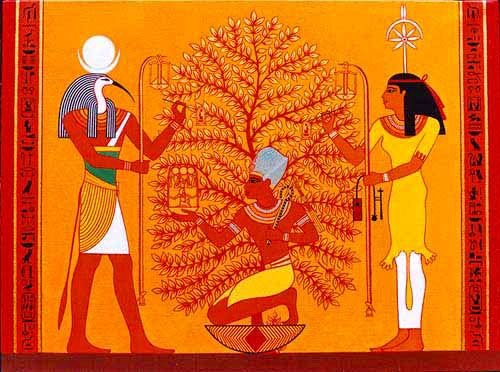
Encyclopedia Britannica: Tree-worship was rooted in the oldest nature worship, and the Church had the utmost difficulty in suppressing it. Councils fulminated against the cult of trees, against offerings to them or the placing of lights before them and before wells or stones, and against the belief that certain trees were too sacred to be cut down or burned. Heavy fines were levied against those who practised these rites, yet still they continued. Amator, Bishop of Auxerre, tried to stop the worship of a large pear-tree standing in the centre of the town and on which the semi-Christian inhabitants hung animals’ heads with much ribaldry. At last S. Germanus destroyed it, but at the risk of his life. S. Martin of Tours was allowed to destroy a temple, but the people would not permit him to attack a much venerated pine-tree which stood beside it–an excellent example of the way in which the more official paganism fell before Christianity, while the older religion of the soil, from which it sprang, could not be entirely eradicated. The Church often effected a compromise. Images of the gods affixed to trees were replaced by those of the Virgin, but with curious results. Legends arose telling how the faithful had been led to such trees and there discovered the image of the Madonna miraculously placed among the branches. These are analogous to the legends of the discovery of images of the Virgin in the earth, such images being really those of the Matres (“Ancient Northern European Goddesses”).
New Schaff-Herzog Encyclopedia of Religious Knowledge: How much the date of the festival depended upon the pagan Brumalia (December 25) following the Saturnalia (Dec. 17-24), and celebrating the shortest day of the year and the ‘new sun’…cannot be accurately determined. The pagan Saturnalia and Brumalia were too deeply entrenched in popular custom to be set aside by Christian influence…The pagan festival with its riot and merry-making was so popular that Christians were glad of an excuse to continue its celebration with little change in spirit and in manner. Christian preachers of the West and the Near East protested against the unseemly frivolity with which Christ’s birthday was celebrated, while Christians of Mesopotamia accused their Western brethren of idolatry and sun worship for adopting as Christian this pagan festival.
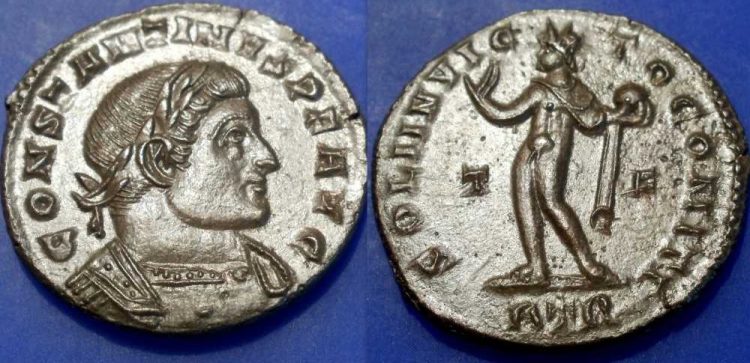
History of the Christian Church, Philip Schaff: At first Constantine, like his father, in the spirit of the Neo-Platonic syncretism of dying heathendom, reverenced all the gods as mysterious powers; especially Apollo, the god of the sun, to whom in the year 308 he presented munificent gifts. Nay, so late as the year 321 he enjoined regular consultation of the soothsayers in public misfortunes, according to ancient heathen usage; even later, he placed his new residence, Byzantium, under the protection of the God of the Martyrs and the heathen goddess of Fortune; and down to the end of his life he retained the title and the dignity of a Pontifex Maximus, or high-priest of the heathen hierarchy. His coins bore on the one side the letters of the name of Christ, on the other the figure of the Sun-god, and the inscription “Sol invictus.” Of course there inconsistencies may be referred also to policy and accommodation to the toleration edict of 313. Nor is it difficult to adduce parallels of persons who, in passing from Judaism to Christianity, or from Romanism to Protestantism, have so wavered between their old and their new position that they might be claimed by both. With his every victory, over his pagan rivals, Galerius, Maxentius, and Licinius, his personal leaning to Christianity and his confidence in the magic power of the sign of the cross increased; yet he did not formally renounce heathenism, and did not receive baptism until, in 337, he was laid upon the bed of death.
Its [paganism’s] best elements took refuge in the church and became converted, or at least took Christian names. The Christmas festival was probably the Christian transformation or regeneration of a series of kindred heathen festivals—the Saturnalia, Sigillaria, Juvenalia, and Brumalia—which were kept in Rome in the month of December, in commemoration of the golden age of universal freedom and equality, and in honor of the unconquered sun, and which were great holidays, especially for slaves and children. This connection accounts for many customs of the Christmas season, like the giving of presents to children and to the poor, the lighting of wax tapers, perhaps also the erection of Christmas trees, and gives them a Christian import; while it also betrays the origin of the many excesses in which the unbelieving world indulges at this season, in wanton perversion of the true Christmas mirth, but which, of course, no more forbid right use, than the abuses of the Bible or of any other gift of God. Had the Christmas festival arisen in the period of the persecution, its derivation from these pagan festivals would be refuted by the then reigning abhorrence of everything heathen; but in the Nicene age this rigidness of opposition between the church and the world was in a great measure softened by the general conversion of the heathen. Besides, there lurked in those pagan festivals themselves, in spite of all their sensual abuses, a deep meaning and an adaptation to a real want; they might be called unconscious prophecies of the Christmas feast. Finally, the church fathers themselves confirm the symbolical reference of the feast of the birth of Christ, the Sun of righteousness, the Light of the world, to the birth-festival of the unconquered sun, which on the twenty-fifth of December, after the winter solstice, breaks the growing power of darkness, and begins anew his heroic career.
Newsweek Magazine: Christmas trees did begin as a pagan tradition as early as the fourth century C.E…. European pagans were largely responsible for dressing their homes with the branches of evergreen fir trees in order to bring color and light into their dull winters. But pagans weren’t the only people to do this. Romans also used the branches for decoration during the festival of Saturnalia, which took place from December 17 to December 23 in honor of the God Saturn. (Kelly Wynne 12/11/18)
Dr. H.A. Ironside: It is a lamentable fact that Babylon’s principles and practices are rapidly but surely pervading the churches that escaped from Rome at the time of the Reformation. We may see evidences of it in the wide use of high-sounding ecclesiastical titles, once unknown in the reformed churches, in the revival of holy days and church feasts such as Lent, Good Friday, Easter, and Christ’s Mass, or, as it is generally written, Christmas. …some of these festivals … when they are turned into church festivals, they certainly come under the condemnation of Galatians 4:9-11, where the Holy Spirit warns against the observance of days and months and times and seasons. All of them, and many more that might be added, are Babylonish in their origin, and were at one time linked with the Ashtoreth and Tammuz mystery-worship. It is through Rome that they have come down to us; and we do well to remember that Babylon is a mother, with daughters who are likely to partake of their mother’s characteristics… (“Lectures on the Book of Revelation” p. 301)
Bibliotheca Sacra: The interchange of presents between friends is a like characteristic of Christmas and the Saturnalia, and must have been adopted by Christians from the pagans, as the admonition of Tertullian plainly shows. (Vol. 12, pp. 153-155)
Dr. William Gutsch, Chairman of the American Museum of Natural History: The early Romans were not celebrating Christmas but rather a pagan feast called the Saturnalia. It occurred each year around the beginning of winter, or the winter solstice. This was the time when the sun had taken its lowest path across the sky and the days were beginning to lengthen, thus assuring another season of growth. If many of the trappings of the Saturnalia, however, seem to parallel what so many of us do today, we can see where we borrowed…our holiday traditions. And indeed, it has been suggested that while Christ was most likely not born in late December, the early Christians—then still an outlawed sect—moved Christmas to the time of the Saturnalia to draw as little attention as possible to themselves while they celebrated their own holiday. (December 18, 1989, The Reporter Dispatch, Westchester, New York)
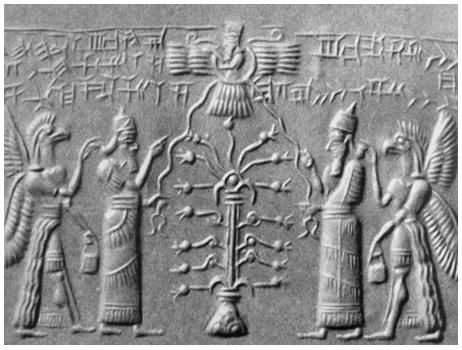
Adam Clarke Commentary: It was custom among Jews to send out their sheep to the deserts about the Passover [early spring], and bring them home at the commencement of the first rain.” The first rains began in early-to-mid fall. Continuing with this same quote: “During the time they were out, the shepherds watched them night and day. As…the first rain began early in the month of March-esvan, which answers to part of our October and November[begins sometime in October], we find that the sheep were kept out in the open country during the whole summer. And as these shepherds had not yet brought home their flocks, it is a presumptive argument that October had not yet commenced, and that, consequently, our Lord was not born on the 25th of December, when no flocks were out in the fields; nor could He have been born later than September, as the flocks were still in the fields by night. On this very ground, the nativity in December should be given up. The feeding of the flocks by night in the fields is a chronological fact…See the quotations from the Talmudists in Lightfoot. (volume 5, page 370)
Myth & Mystery: An Introduction to the Pagan Religions of the Biblical World, Jack Finegan: …But the worship of the sun-god continued widely throughout the empire, and under Aurelian (A.D. 270-275) the cult was restored to its former high estate. In the year 274 Aurelian declared the god — now called Deus Sol Invictus — the official deity of the Roman Empire; he built a splendid temple of the sun in Rome…and set the sun’s birthday celebration (naturalis solis invicti) ON DECEMBER 25, the date then accepted for the winter solstice (also in his solar character the BIRTHDAY OF MITHRAS). In the time of Constantine the cult of Deus Sol Invictus was still at its height, and the portrait of the sun-god was on the coins of Constantine….Likewise it must have been in this time and with the intent to transform the significance of AN EXISTING SACRED DATE that the birthday of Jesus, which had been celebrated in the East on January 6…was placed in Rome ON DECEMBER 25, THE DATE OF THE BIRTHDAY CELEBRATION OF SOL INVICTUS. This date appears in a list of dates probably compiled in A.D. 336 and published in the Roman city calendar, edited by Filocalus, for the year 354″ (p. 211-212).
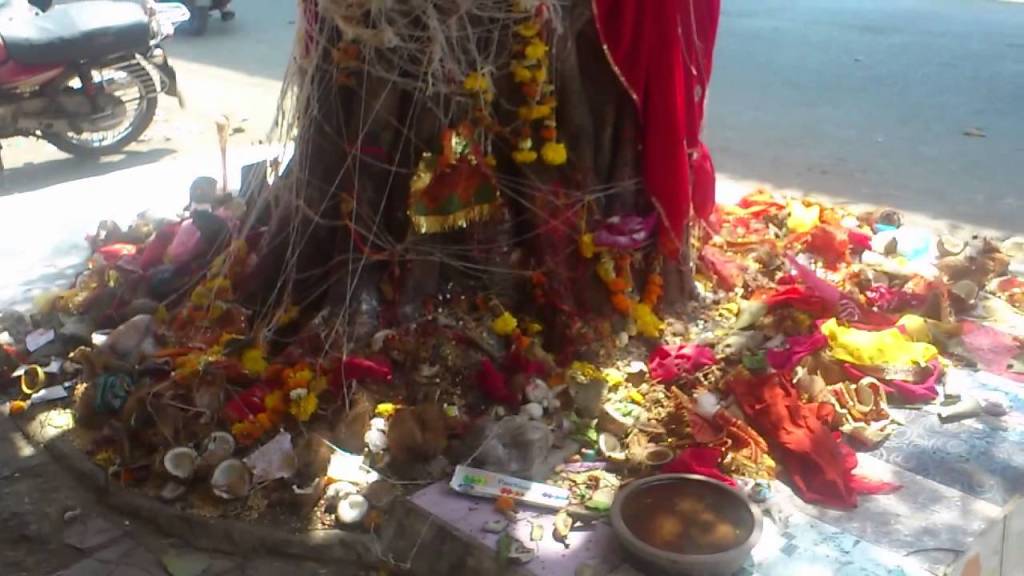
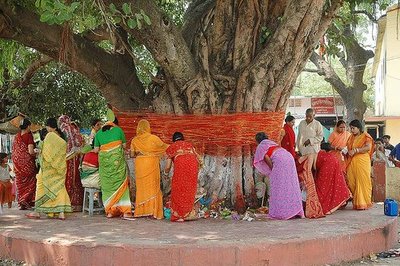
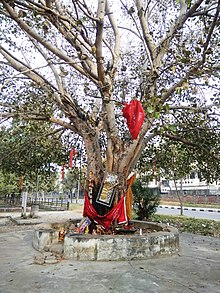
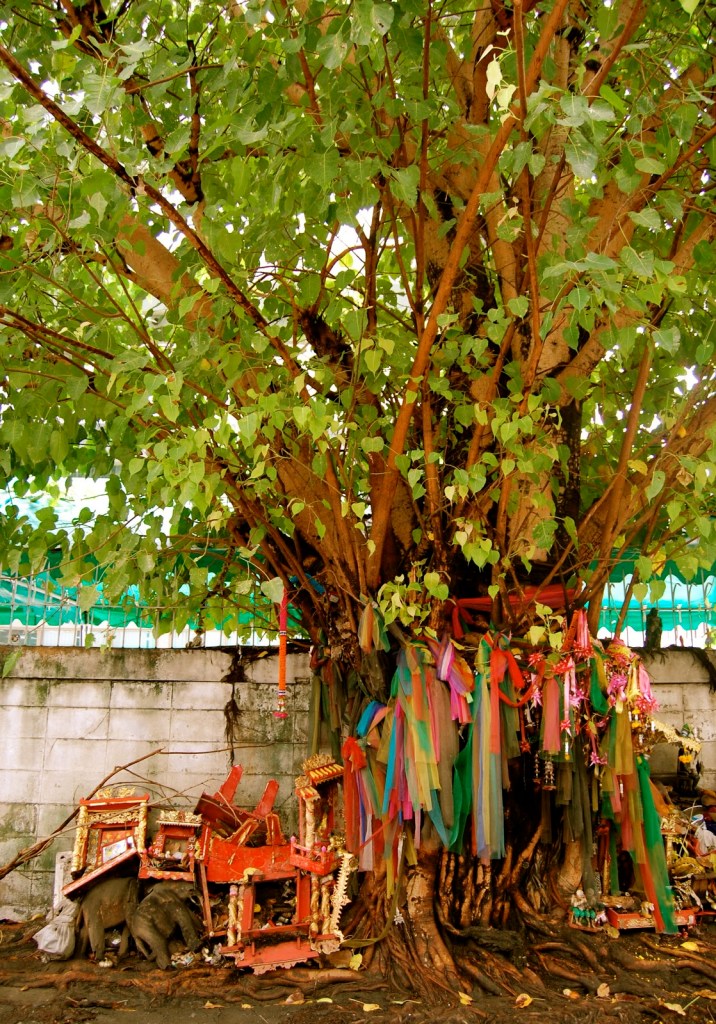
See below, modern examples of tree worship in India. They place offerings below the tree, decorate the tree with ornaments, and gather around the tree to worship. These are ancient pagan rituals that have crept into Christianity.

History Channel: The middle of winter has long been a time of celebration around the world. Centuries before the arrival of the man called Jesus, early Europeans celebrated light and birth in the darkest days of winter. Many peoples rejoiced during the winter solstice, when the worst of the winter was behind them and they could look forward to longer days and extended hours of sunlight.
In Scandinavia, the Norse celebrated Yule from December 21, the winter solstice, through January. In recognition of the return of the sun, fathers and sons would bring home large logs, which they would set on fire. The people would feast until the log burned out, which could take as many as 12 days….
The end of December was a perfect time for celebration in most areas of Europe. At that time of year, most cattle were slaughtered so they would not have to be fed during the winter. For many, it was the only time of year when they had a supply of fresh meat. In addition, most wine and beer made during the year was finally fermented and ready for drinking.
In Germany, people honored the pagan god Oden during the mid-winter holiday. Germans were terrified of Oden, as they believed he made nocturnal flights through the sky to observe his people, and then decide who would prosper or perish. Because of his presence, many people chose to stay inside.
In Rome, where winters were not as harsh as those in the far north, Saturnalia—a holiday in honor of Saturn, the god of agriculture—was celebrated. Beginning in the week leading up to the winter solstice and continuing for a full month, Saturnalia was a hedonistic time, when food and drink were plentiful and the normal Roman social order was turned upside down. For a month, slaves would become masters. Peasants were in command of the city. Business and schools were closed so that everyone could join in the fun.
Also around the time of the winter solstice, Romans observed Juvenalia, a feast honoring the children of Rome. In addition, members of the upper classes often celebrated the birthday of Mithra, the god of the unconquerable sun, on December 25. It was believed that Mithra, an infant god, was born of a rock. For some Romans, Mithra’s birthday was the most sacred day of the year.
In the early years of Christianity… the birth of Jesus was not celebrated. In the fourth century, church officials decided to institute the birth of Jesus as a holiday. Unfortunately, the Bible does not mention date for his birth (a fact Puritans later pointed out in order to deny the legitimacy of the celebration). Although some evidence suggests that his birth may have occurred in the spring (why would shepherds be herding in the middle of winter?), Pope Julius I chose December 25. It is commonly believed that the church chose this date in an effort to adopt and absorb the traditions of the pagan Saturnalia festival. First called the Feast of the Nativity, the custom spread to Egypt by 432 and to England by the end of the sixth century.
By holding Christmas at the same time as traditional winter solstice festivals, church leaders increased the chances that Christmas would be popularly embraced, but gave up the ability to dictate how it was celebrated. (www.history.com/topics/christmas/history-of-christmas. Accessed: December 30, 2019)
 Bethel Cornerstone