
But if all prophesy, and an unbeliever or an uninformed person comes in, he is convinced by all, he is convicted by all. And thus the secrets of his heart are revealed; and so, falling down on his face, he will worship God and report that God is truly among you.
1 Cor. 14:24-25
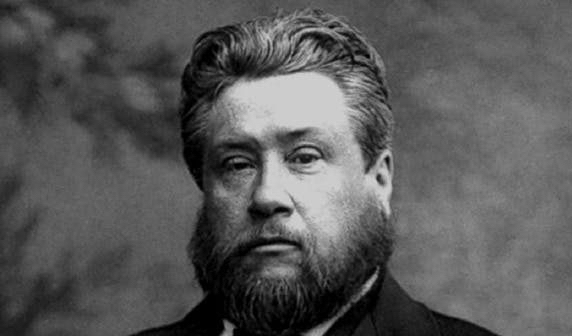
He suddenly broke off from his [sermon] subject, and pointing in a certain direction, said, “Young man, those gloves you are wearing have not been paid for: you have stolen them from your employer.” At the close of the service, a young man, looking very pale and greatly agitated, came to the room which was used as a vestry, and begged for a private interview with Spurgeon. On being admitted, he placed a pair of gloves upon the table, and tearfully said, “It’s the first time I have robbed my master, and I will never do it again. You won’t expose me, sir, will you? It would kill my mother if she heard that I had become a thief.”
The Autobiography of Charles H. Spurgeon, [Curts & Jennings, 1899], Vol. II, pp. 60
While preaching in the hall, on one occasion, I deliberately pointed to a man in the midst of the crowd, and said, ‘There is a man sitting there, who is a shoemaker; he keeps his shop open on Sundays, it was open last Sabbath morning, he took ninepence, and there was fourpence profit out of it; his soul is sold to Satan for fourpence!’ A city missionary, when going his rounds, met with this man, and seeing that he was reading one of my sermons, he asked the question, ‘Do you know Mr. Spurgeon?’ ‘Yes,’ replied the man, ‘I have every reason to know him, I have been to hear him; and, under his preaching, by God’s grace I have become a new creature in Christ Jesus. Shall I tell you how it happened? I went to the Music Hall, and took my seat in the middle of the place; Mr. Spurgeon looked at me as if he knew me, and in his sermon he pointed to me, and told the congregation that I was a shoemaker, and that I kept my shop open on Sundays; and I did, sir. I should not have minded that; but he also said that I took ninepence the Sunday before, and that there was fourpence profit out of it. I did take ninepence that day, and fourpence was just the profit; but how he should know that, I could not tell. Then it struck me that it was God who had spoken to my soul though him, so I shut up my shop the next Sunday. At first, I was afraid to go again to hear him, lest he should tell the people more about me; but afterwards I went, and the Lord met with me, and saved my soul.
In this example, we should not commend Spurgeon’s religious scruple about Sabbath-keeping. The New Testament says that the one day a week observance of the Sabbath was a shadow of the fullness of Christ. We are not obligated to keep the Sabbath as a one day a week religious observance (Col. 2:14-17). The Old Testament Sabbath is a symbol of the fullness that was brought to us by Jesus. For Christians, keeping the Sabbath means to rest in God all the time – doing his will, and not just doing our own things every day (see Hebrews 3 and 4).
In spite of Spurgeon’s religious scruple about the Sabbath, we can appreciate the fact that the Holy Spirit was moving him to prophesy, even if he colored his prophesying with his own religious scruple. His human coloration of this prophecy actually sheds light on how a prophecy can be affected by the particular beliefs of the one prophesying.
Spurgeon Prophesied Frequently
I could tell as many as a dozen similar cases in which I pointed at somebody in the hall without having the slightest knowledge of the person, or any idea that what I said was right, except that I believed I was moved by the Spirit to say it; and so striking has been my description, that the persons have gone away, and said to their friends, ‘Come, see a man that told me all things that ever I did; beyond a doubt, he must have been sent of God to my soul, or else he could not have described me so exactly.’ And not only so, but I have known many instances in which the thoughts of men have been revealed from the pulpit. I have sometimes seen persons nudge their neighbours with their elbow, because they had got a smart hit, and they have been heard to say, when they were going out, ‘The preacher told us just what we said to one another when we went in at the door’”
(The Autobiography of Charles H. Spurgeon, [Curts & Jennings, 1899], Vol. II, pp. 226-227
Conclusion
Spurgeon remarked about how many similar experiences he had, when he spoke about things that were revealed to him by the Holy Spirit. This is supernatural ministry. This is supposed to be normal Christian ministry, for our God is supernatural.
It is interesting to note that Spurgeon would not have called these experiences prophesying. Spurgeon defined prophesying as speaking in an infallible way that would potentially add to the words of the Bible.
However, this is not how the New Testament defines prophesying. The New Testament defines prophesying as someone speaking out the word of God by revelation from the Holy Spirit. Spurgeon was certainly doing that, for he was revealing facts that could only have been revealed to him by the Holy Spirit.
These events in the ministry of Spurgeon provide further evidence that the spiritual gifts are operating in modern times – not just through crazy Charismaniacs, but through solid men of God like Charles Spurgeon.
 Bethel Cornerstone