
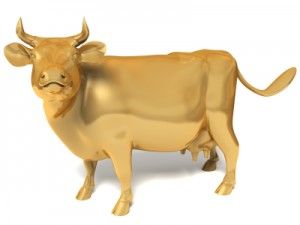
“Now when the people saw that Moses delayed coming down from the mountain, the people gathered together to Aaron, and said to him, “Come, make us gods [elohim] that shall go before us; for as for this Moses, the man who brought us up out of the land of Egypt, we do not know what has become of him” (Ex. 32:1).
In Exodus 32:1, we see the word Elohim. This word can either be translated as gods – referring to the gods of the nations, or God – referring to Almighty God (the plural of majesty).
Does Elohim in this verse refer to gods or God? Were the Israelites asking Aaron to make a false god representing a demon or an image representing the true God?
This is an important question.
If gods is meant, then this means the Israelites were turning away from God to a false god. However, if God is meant, then they were trying to worship the true God using a golden cow. If this is the case, then this is a powerful example of vain worship – an attempt to worship God that is not according to God’s word.
Jesus said, “those who worship God must worship him in Spirit and in truth” (John 4:24).
True worship must be according to the word of God and authored by the Holy Spirit. If otherwise, it’s not worship of the one true God.
In the Old Testament, the word Elohim is most frequently used to represent true God, Yahweh. The word is used this way over 2,500 times.
In ancient times, many cultures made images of cows for religious purposes. These cows were seen as the thrones of deity, and spiritual beings were believed to dwell on them.
It [the golden cow] was understood as a pedestal for a deity. In ancient Near Eastern art, deities in human form are often shown standing on an animal, an alternative to being seated on a throne. The golden calf, then, may be interpreted as an alternative to the cherubim and ark, on which Yahweh was invisibly enthroned. (Coogan, A Brief Introduction to the Old Testament).
In Exodus 32, the Israelites probably believed that they were building a throne on which their God, Yahweh, would dwell. They believed this would help them worship God, without waiting for Moses and for God’s actual instructions.
Most commentators agree that the word Elohim in Exodus 32:1 should be translated God.
Commentaries and Theologians
“Aaron made a golden calf (that is, a bull–image). It was meant as a visible symbol of Jehovah, the mighty God who had brought Israel out of Egypt.” (J.I. Packer – Knowing God).
The Cambridge Commentary says that the word Elohim is used in this verse for the true God, and that the “image represents Jehovah”.
Benson notes that “it should be translated “make us a god, as אלהים Elohim is generally rendered, and ought to be rendered here, as Le Clerc observes, and that for two plain reasons: 1st, Aaron made but one calf, one idol-god; 2d, It appears from Exodus 32:5 that this symbol was consecrated to Jehovah alone”.
Jamieson, Faussett, and Brown note that “The Hebrew word rendered “gods” is simply the name of God in its plural form.” The cow was an image or representation of God, “whom, after the manner of idolaters, they call by God’s name”.
Keil and Delitzsch note that the golden cow “was not the image of an Egyptian deity – it was not symbol of the generative or bearing power of nature, but an image of Jehovah. For when it was finished, those who had made the image, and handed it over to the people, said, “This is thy God (plurals majest.), O Israel, who brought thee out of Egypt. This is the explanation adopted in Psa 106:19-20.
“They made a calf in Horeb and worshipped the molded image. Thus they changed their glory into the image of an ox that eats grass.” Psa 106:19-20
According to Psalm 106, the cow was made to represent Yahweh. The Israelites thereby changed the invisible glory of God into an image like a cow. This cow was not an attempt to worship Baal or another false god. It was an attempt to worship God according to their own religious ideas.
Exodus 32:4
And he received the gold from their hand, and he fashioned it with an engraving tool, and made a molded calf. Then they said, “This is your god, O Israel, that brought you out of the land of Egypt!” Ex. 32:4
In verse 4, the same word elohim is used. Again, God is the correct translation, as most commentators agree.
Jamieson says, “They meant the calf to be an image, a visible sign or symbol of Jehovah”.
The Pulpit Commentary says, “The calf when made was not viewed as an image of any Egyptian god, but as a representation of Jehovah (ver. 5)”.
Ellicott states that the word should be translated as God. “Certainly the bull form was more distinctive of the Babylonian and Assyrian than of the Egyptian worship, and it may he suspected that the emigrants from Chaldæa had clung through all their wanderings to the mystic symbolism which had been elaborated in that primæval land, and which they would contrast favourably with the coarse animal worship of Egypt. In Chaldæa, the bull, generally winged and human-headed, represented the combination of wisdom, strength, and omnipresence, which characterises divinity; and this combination might well have seemed to carnal minds no unapt symbol of Jehovah.”
Benson says, “This is the image or symbol of thy God; who brought thee out of Egypt — For they intended to worship the true God, by this image, as afterward Jeroboam did by the same image, it being incredible that the generality of the Israelites should be so void of all sense and reason, as to think that this new-made calf brought them out of Egypt, even before its own creation, and that this was the same Jehovah that had so lately spoken to them from heaven with an audible voice, saying, “I am the Lord thy God who brought thee out of the land of Egypt.”’
Barnes says, “In the next verse, Aaron appears to speak of the calf as if it was a representative of Yahweh – “Tomorrow is a feast to the Lord.” The Israelites did not, it should be noted, worship a living Mnevis, or Apis, having a proper name, but only the golden type of the animal. The mystical notions connected with the ox by the Egyptian priests may have possessed their minds, and, when expressed in this modified and less gross manner, may have been applied to the Lord, who had really delivered them out of the hand of the Egyptians. Their sin then lay, not in their adopting another god, but in their pretending to worship a visible symbol of Him whom no symbol could represent. The close connection between the calves of Jeroboam and this calf is shown by the repetition of the formula, “which brought thee up out of the land of Egypt” 1 Kings 12:28.”
Nehemiah’s Translation
We need not depend upon commentators to reveal the shocking truth that Israelites were trying to worship God using a golden cow. The Bible itself tells us.
Nehemiah 9:18 quotes Exodus 32:4.
“Even when they made a molded calf for themselves, and said, “This is your God that brought you up out of Egypt,” and worked great provocations” (Neh 9:18)
Here, Nehemiah quotes the statement of the Israelites in Exodus 32:4. Almost all translators agree that the word Elohim here should be translated God. If Elohim should be translated God here, then it should be translated God in Exodus 32:4, for this verse is a direct quotation of Exodus 32:4.
Exodus 32:5
So when Aaron saw it, he built an altar before it. And Aaron made a proclamation and said, “Tomorrow is a feast to Yahweh”. (Ex. 32:5)
Exodus 32:5 makes it abundantly clear that the Israelites were trying to worship God with their cow. The entire religious celebration which was centered on this cow was dedicated to Yahweh.
Ellicot says, “In [Aaron’s] view no doubt the calf was an emblem of Jehovah, and the worship paid it was the worship of Jehovah. Hence the festival which he proclaimed was to be “a feast to Jehovah.”’
The Cambridge Commentary says, “The calf is thus clearly regarded, not as exclusive of Jehovah, but as representing Him.”
Benson notes that “the people did not intend to terminate their adoration in the image, but designed to worship the true God in and by this calf, which they meant to consider as only a visible token of God’s presence with them, and a medium by which to convey their worship to him.”
Jamieson says that Aaron’s proclamation is “strongly confirmatory of the view that they had not renounced the worship of Jehovah, but in accordance with Egyptian notions, had formed an image with which they had been familiar, to be the visible symbol of the divine presence.”
Matthew Poole remarks, “the people designed to worship the true God in this calf, which they made only as a visible token of God’s presence with them, and an image by which they might convey their worship to God.”
To Aaron and all the Israelites, the golden cow and their newly proclaimed feast was to worship Yahweh, not a foreign god.
Conclusion
It is clear from abundant evidence that the word elohim in Exodus 32 verses 1 and 4 should be translated God.
The Israelites made the cow to represent Jehovah. They took a pagan religious practice and called it by the name of Almighty God.
God did not say that this was ok. He said this was a terrible abomination. Because of this, he almost destroyed the entire nation of Israel.
This event is recorded as a lesson to all future generations of God’s people. It reveals that it is impossible to worship Almighty God using pagan practices.
We cannot worship God in any way that we please. We must submit to him. This is the beginning of true worship.
God can only be worshiped according to his word. We have no right to add to the word of God or take away from it, worshiping God according to religious practices that are not found in the Bible. If we do, we will find ourselves caught in the same deception as Aaron and the ancient Israelites, an error which later deceived the Pharisees.
“In vain do they worship me, teaching for doctrines the commandments of men” (Matt. 15:9).
 Bethel Cornerstone